Banned from Hinge forever: is a Hinge ban permanent?
By default, yes: no end date, and every account action Hinge reported to the EU for 2025 was a termination. Permanent is not final. Hinge reversed 31,251 of its own bans that year, and several routes that make it look again are still open.
Intake first. Payment after. Not taken on = refunded.

Pick what you think set it off. We email you a statement written for that trigger, short and calm, ready to paste into the Appeal box.
We send it now, then one email in three days to ask what Hinge said. One click unsubscribes.
A Hinge ban is permanent in the sense Hinge means: nothing counts down, and no page Hinge publishes gives a ban an end date. Its 2025 EU transparency report lists 633,534 account measures for breaking its terms, and every one is a termination. It is not permanent in the sense that matters to you, because Hinge reversed 31,251 of its own bans that year when people appealed. AppealMyBan handles exactly this, old bans included: we write the in-app appeal you send, and file the escalation, the access request and the EU dispute body in your name. The tiers are on the pricing page. Grindr says the same of devices: Grindr device ban: does Grindr ban your phone.
AppealMyBan is an independent service. Not affiliated with, or endorsed by, Hinge or Match Group.
The appeal screen itself is covered in how to appeal a Hinge ban, and the causes in banned from Hinge for no reason. This page is about the word forever.
- What Hinge’s Terms and help centre say
- The two-year figure is a retention window
- Why a Hinge ban follows you to Tinder, and back
- Why Hinge keeps banning new accounts
- The evidence that Hinge bans are reversed
- The windows that matter, including for an old ban
- What the appeal statement should say
- What we file for a Hinge ban
- What does not work, and what we cannot promise
- Questions people actually ask
What Hinge’s own Terms and help centre say about a permanent ban
Hinge’s own pages use the word. The Community Guidelines, updated 22 April 2026: “your account may be permanently banned”. The help article Why was my account banned?, updated 29 June 2026: “If your account is Banned, you will not be able to create a new Hinge account. However, you can Submit an Appeal.” The examples Hinge added to its Community Guidelines on 22 April 2026 are listed in banned from Hinge for no reason in 2026.
The ban screen is where the one date lives. Hinge’s appeal article says “Your specific screen will provide details unique to your situation”, and the screen published in the founder’s own case prints two sentences that matter here: “If you believe this was an error, you may submit an appeal by no later than 17 January 2024. Otherwise, your account will remain permanently banned.” and “If you choose not to pursue an appeal or your appeal is not successful, your account will remain permanently banned and any new accounts will be immediately removed.” Below them sits a link for EU residents to “seek resolution through a certified settlement body or judicial remedies”. Read your own screen to the end before you do anything else. If you cannot tell whether a closed account was banned or deleted, see Hinge account deleted.
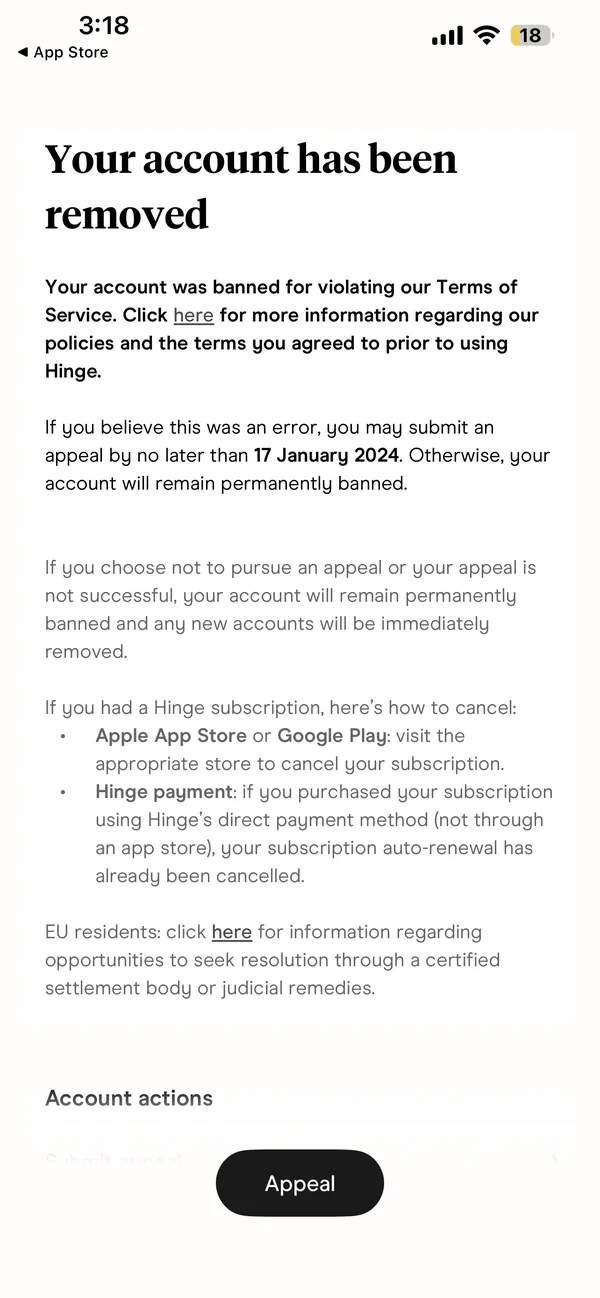
The Terms of Use, effective 25 August 2025, reserve the right at section 9 to “suspend, terminate, or ban your account” “in our sole discretion”. Suspend is in the contract, not the practice. Hinge’s 2025 EU transparency report, filed on Match Group’s safety resources page, records 633,534 measures against accounts for breaking its terms, all of them terminations, and says of account suspension: “The brand does not apply this restriction or remediation.” The grounds those measures were filed under are in why Hinge bans people.
So a Hinge ban lasts until Hinge reverses it. The eligibility rule in section 2a has no date in it: you may use Hinge only if you “have not previously been removed from our Services or our affiliates’ services by us or our affiliates, unless you have our express written permission”. And Hinge may not tell you why. Its help article says “In some cases, banned users will see a reason for their ban on an in-app screen. In many cases, we do not provide specific details about bans”, and adds: “We do not respond to inquiries requesting further details about bans. Ban reason information is not included in data export requests.”
We work out which routes are actually open to you, write the appeal where the app gives you a box for one, and file the routes outside the app in your name, the first inside 48 hours. We never ask for your password. Intake first, payment after.
Get my case built - $149The two-year figure is a retention window, not a sentence
The two years people quote comes from Hinge’s Privacy Policy, section 9, applying from 24 November 2025: “a safety retention window of three months following account closure or up to two years following an account ban”. It is a window for investigating “unlawful or harmful conducts”. It does not end the ban. The other apps’ published periods, up to Bumble’s fifteen years, are in how long dating apps keep a ban on file.
The same section keeps another category with no end date: “data necessary to prevent members who were banned from opening a new account for as long as necessary to ensure the safety and vital interests of our members.” The Face Check article, updated 29 July 2026, keeps three audit images from your video selfie “up to the duration of the account ban”. Waiting is not a route: year three looks like month three.

Why a Hinge ban follows you to Tinder, and back
Hinge’s Terms, section 4, allow “banning you from our Services and/or our affiliates’ services (such as Tinder, OkCupid, Match, Meetic, BLK, LoveScout24, OurTime, and Pairs” and “preventing you from creating new accounts”. The Privacy Policy covers the other direction: “If you were banned from another Match Group service, your data can be shared with us to allow us to take necessary actions, including closing your account or preventing you from creating an account on our service.” So an old Tinder ban can close a Hinge account that did nothing, and the reverse.
In the founder’s own case, Hinge’s Data Protection Office confirmed in writing on 26 August 2026 that the Hinge ban had begun on Tinder and could not be reinstated unless and until the Tinder ban was overturned. A senior Trust and Safety reviewer had upheld the Hinge ban because the affiliate’s ban remained in effect. When the origin is Tinder, the Hinge reviewer checks one thing: whether Tinder’s ban still stands.
So find the origin and fight it there first. Banned from Tinder and Hinge on the same day covers the two-app version. Bumble and Badoo belong to Bumble Inc., and no published document shares bans between the two groups.
Why Hinge keeps banning new accounts
“Hinge keeps banning me” nearly always means a new account, a few days of use, then the same screen. Section 2c of the Terms lists it as a prohibited action: “Create a new account after we suspend or terminate your account, unless you receive our express permission”, and the Privacy Policy keeps the data that stops re-registration for as long as necessary. What Hinge says it compares and keeps is in can you get around a Hinge ban. The reasons Tinder and Hinge name for a ban on a new account are in banned straight after signing up.
The Privacy Policy lists what Hinge collects: the phone number, email address and date of birth you give at sign-up, and the IP address, device ID and advertising IDs the app gathers. Where Face Check is required, your “FaceVector is compared to FaceVectors for other accounts”, and verification data may be shared between Match Group affiliates for “identifying and banning violating accounts”. Any one of those can link a new account to the old one.
Each caught account is a fresh breach on the same file, and a second reason to refuse the first appeal. We never advise a new account. The device-ban guide explains why a reinstall changes nothing.
The evidence that Hinge bans are reversed
The Digital Services Act makes Hinge publish how its complaints system performs. Its 2025 report gives these figures:
| Hinge, EU, 2025 | Figure |
|---|---|
| Account terminations | 633,534 |
| After detection by automation alone | 445,488 |
| Complaints about account decisions | 86,650 |
| Upheld | 55,399 |
| Reversed | 31,251 (36.1%) |
| Median time to decide | 19 hours |
| Disputes at certified EU bodies | 636: 161 reversed, 136 upheld |
In one year 31,251 permanent bans ended, lifted by the company that imposed them. Most people never ask: 86,650 complaints against 633,534 terminations is about one in seven. About 70 per cent of terminations followed detection by automation alone, while appeals, in the words of Match Group’s 2025 DSA Safe Dating Report, are “reviewed by a dedicated team of human reviewers who are separate from the content moderation team”. Those are Hinge’s own EU figures, covering everyone who filed. We publish no success rate of our own.
The case check is free and takes two minutes. It tells you which routes are open on your ban, including the cases where it tells you not to pay anyone.
The windows that matter, including for an old ban
No window closes because the ban is permanent. The windows belong to the routes.
| Route | Window | Who sends it |
|---|---|---|
| In-app appeal | The date on your ban screen, where it prints one; none in Hinge’s Terms; the EU floor is six months (DSA Article 20(1)) | Only you, from the banned login |
| Match Group escalation desk | Once, after the in-app appeal, with its ticket reference | Anyone, in your name |
| Platform Control, Germany | One year from the decision; no prior appeal needed; EU and EEA | Anyone, in your name |
| ADR Center, Italy | Twelve months from the decision, after the in-app complaint | Anyone, with proof of authority |
| ADR Point, Greece | After the in-app complaint, with ID; no stated deadline, so treat it as twelve months | You, with assistance allowed |
| Access request | No expiry on the right; answer due in one month, 45 days in California | Anyone, in your name |
For an old ban: read the screen first. If it prints an appeal-by date that has passed, Hinge’s own queue is closed, and the routes outside it in the table above are what is left. The Appeal button can still show after that date, as it does on the founder’s ban screen; the screen’s own words are what count. If it prints no date and still shows Appeal, and you never used it, start there. A ban more than a year old has usually aged out of all three EU bodies. The access request does not age, because Hinge holds the re-registration data for as long as necessary. The clause that keeps the ban alive keeps your access right alive.
In the founder’s own case, Hinge’s Data Protection Office withheld report contents and moderation records under GDPR Article 15(4), but answered within two days which Match Group service the ban began on. Expect an identity check first, and a download link that expires in 48 hours. Ask for access, never erasure: erasure removes no ban record and takes your evidence with it.

What the appeal statement should say
The in-app box asks “why you believe your account did not violate our Terms of Use”, in the words of Hinge’s appeal article, updated 30 June 2026. It does not ask whether forever is fair. Four short paragraphs:
- What happened, with dates. The day of the ban screen, your last conversation, any profile change.
- The likely trigger, named. A report, a verification mismatch, a payment dispute. If any Match Group app has banned you, say which and when: Hinge can see that link.
- The context the reviewer lacks. They hold the report, not your side of it.
- One real person. You can verify with government ID today, and you ask for a human review of the original decision.
An invented example: “My account was banned on 3 March 2025, with no category named. Tinder banned me in 2022 after a failed photo verification on the same phone number, and I believe Hinge matched that record. I use one Hinge account, in my own name, and can verify with a passport today. I have asked Tinder to review its ban, and I ask for a human review of this one.”
Keep it short and specific: Hinge prints no length limit, but a reviewer needs facts they can check, not length. Send it once, and keep the reference number on the safety team’s email for the escalation desk. How to write a ban appeal has the full structure.
Pick what you think set it off. We email you a statement written for that trigger, short and calm, ready to paste into the Appeal box.
We send it now, then one email in three days to ask what Hinge said. One click unsubscribes.
That statement is the one filing only you can send. Everything else can go in your name.
What we file for a Hinge ban, old ones included
AppealMyBan takes Hinge bans, including ones months or years old. You confirm the facts at intake; we write the words and send everything a third party may send, copying you the moment each one goes.
- The origin check and access request. To Hinge’s data office in your name: which service the ban began on, and which accounts and identifiers are linked. The Case, $149.
- The in-app appeal statement. Written from your facts. You press send, because only the banned login can. The Case.
- The origin app, if it is not Hinge. Tinder’s Appeals Center takes no written statement, so you press Submit there and the written case goes to the escalation desk. The Case.
- The Match Group escalation desk. One filing in your name, with the ticket reference (how the desk works). The Case.
- The follow-through. Every reply answered for 60 days, one step higher if they say no, the data regulator if Hinge ignores the access request, and money taken after the ban chased. The Case.
- The EU dispute body and the post. For EU and EEA residents inside the window, Platform Control, ADR Center or ADR Point built end to end, signed letters printed and posted, first filing within 24 hours, 90 days of replies. The Advocate, $349.
On The Case the first filing goes within 48 hours of us having everything we need. Start with the intake for The Case, compare tiers on the pricing page, or run the free case check. An account that still opens but went quiet with no ban notice is not a ban: the Data Route is built for that.
What does not work, and what we cannot promise
- A new account. A breach of section 2c, matched on your face, number, email or device.
- A VPN. It changes the IP address and nothing else on Hinge’s list.
- A chargeback. The Terms: if you “initiate a chargeback or otherwise reverse a payment”, Hinge “may terminate your account immediately in its sole discretion”. The money guide has the routes that work.
- Emailing staff, or posting at Hinge on social media. Appeals “submitted via social media or sent to individual Hinge or Match Group employees via email will not be processed”, and chasing “may alter your position in our processing queue”. Hinge’s Terms also print hello@hinge.com, which refused connections in the founder’s own case from 25 to 27 August 2026; the working address is hello@hinge.co.
- Waiting two years. The retention window closes. The re-registration data stays.
What we cannot promise: that Hinge reverses the ban, how fast anyone replies, or that an EU body’s decision binds Hinge, which Article 21(2) of the Digital Services Act says it does not. We decline real harassment, threats, violence, anything touching minors, and fraud the person actually did. An accusation alone is none of those, and we take those cases.
Questions people actually ask
Is a Hinge ban permanent?
By default, yes. Hinge’s Community Guidelines say an account “may be permanently banned”, and no Hinge page gives a ban an end date. Banned from Hinge forever is the default until a route makes Hinge look again, and in 2025 it reversed 31,251 bans.
How long does a Hinge ban last?
Until Hinge reverses it. Hinge’s 2025 EU report says it does not apply account suspensions, so there is no timed ban to wait out, and nothing in its Terms sets a length.
Why did Hinge permanently ban me?
Hinge may not say. Its help centre says some banned users see a reason on the ban screen and many do not, and it answers no follow-up questions about bans. The usual hidden causes are a report from another user, an old ban on a sibling Match Group app, a verification mismatch and a payment dispute.
Why does Hinge keep banning me?
Because each new account is matched to the old ban through your phone number, email, device identifiers or, where Face Check applies, your face. Hinge’s Terms bar a new account after a ban, so every caught account is a fresh breach on the same file. The fix is the original decision.
Can you get unbanned from Hinge?
Some people do: Hinge reversed 31,251 of the 86,650 account appeals it received in the EU in 2025, at a median of 19 hours. That is Hinge’s number, and the decision is Hinge’s alone. If the ban came from Tinder, fight Tinder first.
Banned from Hinge, how do I get back?
Through the original account, never a new one. Appeal in the app from the banned login, then the Match Group escalation desk, then an EU dispute body if you live in the EU, with an access request alongside. If the ban began on Tinder, appeal Tinder first.
Does a Hinge ban expire after two years?
No. The Privacy Policy keeps some data for “up to two years following an account ban”, which is a retention period. The same policy keeps the data that stops a banned member opening a new account “for as long as necessary”, with no end date.
Can I appeal a Hinge ban from years ago?
Some routes stay open. Hinge’s Terms print no deadline for its in-app appeal, but the ban screen can, so read it: if it gives no date, still offers Appeal, and you never used it, start there. The EU bodies count from the decision. The access request has no expiry as a right, and we take old Hinge bans on every tier.
Does Hinge ban your phone or device?
Hinge’s pages never use the words device ban. They say something broader: its Terms of Use, effective 25 August 2025, bar anyone “previously removed from our Services or our affiliates’ services” and reserve “any personal, technological, legal, or other means available to enforce the Terms”. Its Privacy Policy keeps “data necessary to prevent members who were banned from opening a new account for as long as necessary”, and Hinge requires a phone number and an email to create an account. Where Face Check applies, a face template is kept for the life of the account and the result for 2 years if the account is banned. Hinge does not list which identifiers it matches, so a new phone clears only one of several possible links; that is our reading.

Written by the case team at AppealMyBan - the same team that drafts the appeals. Banned for years, built this out of the frustration.